Academia
University of Konstanz, Department of Physics
The Department of Physics at the University of Konstanz has a long history of research into quantum phenomena. In the Collaborative Research Center “Fluctuations and Nonlinearities in Classical and Quantum Matter Beyond Equilibrium,” quantum fluctuations in electromagnetic fields, magnetic materials, and nanomechanical systems are investigated. Quantum physics and quantum information are among the key focuses of research and teaching in the department. The research encompasses quantum computing based on solid-state systems—in particular semiconductors and superconductors—as well as the theory of quantum computing, quantum error correction, and the modeling of noise and error sources.
Research
- Semiconductor qubits
- Superconducting qubits
- Quantum algorithms, quantum simulation, quantum error correction
- Open Quantum Systems, Noise, Fluctuation, and Error Processes


Activities
Member of the Baden-Württemberg Quantum Computing Competence Center (KQCBW)
KQCBW
As a member of the Baden-Württemberg Center of Excellence for Quantum Computing (KQCBW) the University of Konstanz is involved in the development and analysis of fault-tolerant quantum methods, as well as in research on resilient quantum algorithms and quantum architectures.
Get more information
Co-founder and organizer of the International Conference “Spin-Based Quantum Information Processing (SpinQubit)”
SpinQubit Conference
SpinQubit is an international conference on spin-based quantum information processing. The event covers various spin-qubit platforms, including silicon- and germanium-based approaches as well as quantum dot systems. In addition, current developments in the fabrication of quantum devices, quantum algorithms, and cryogenic control electronics will be presented and discussed.
Get more information
QLSI (Quantum Large Scale Integration in Silicon) is an EU-funded Horizon 2020 project. It aims to demonstrate that silicon spin qubits are a compelling platform for scaling to very large numbers of qubits.
QLSI
QLSI (Quantum Large Scale Integration in Silicon) is a Horizon 2020 project dedicated to researching silicon spin qubits as a platform for scalable quantum computers. The project’s goal is to demonstrate that silicon spin qubits are suitable for scaling to very large numbers of qubits. To this end, QLSI is developing and testing, among other things, 16-qubit processors, high-fidelity quantum operations, and open-access demonstrators for the research community. In addition, requirements for scaling up to systems with more than 1,000 qubits are being investigated and documented.
Get more information
QuSPARC is developing quantum technologies with a spin-photon architecture for Thousand-Qubit Chipsets at Telecom Wavelengths
QuSPARC
QuSPARC is conducting research on silicon carbide (SiC) as a platform for scalable quantum information and quantum communication technologies. The project is developing wafer-based fabrication processes to create thousands of nearly identical qubit sites with spin control, as well as optical interfaces based on high-quality microresonators. The goal is to develop and optimize methods for controlling and reading out selected spin centers in silicon carbide as the foundation for fault-tolerant quantum systems.
Get more informationDiscover More Content
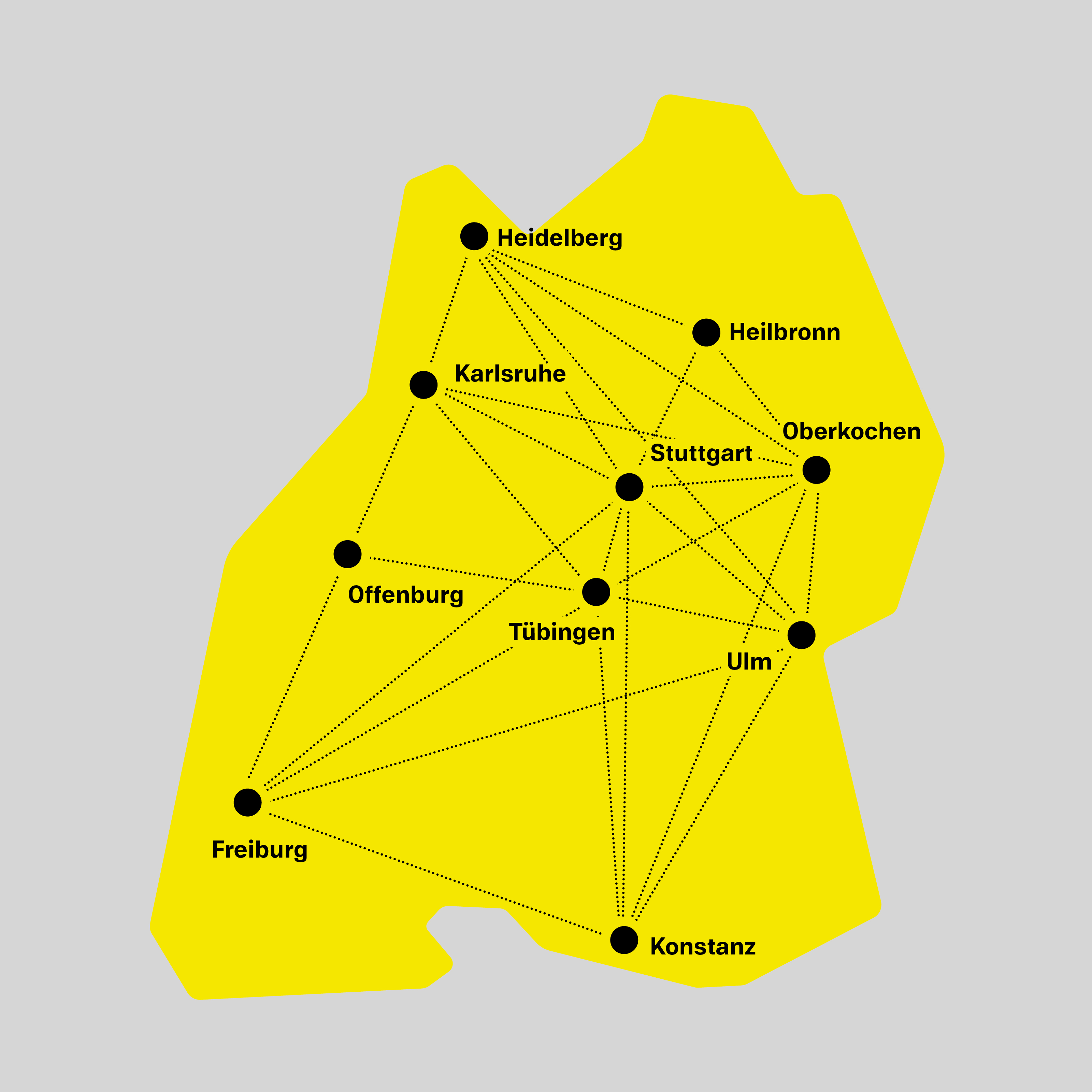
Become part of Baden-Württemberg’s quantum ecosystem
Are you working on quantum technologies in Baden-Württemberg and would like to learn more about the QuantumBW initiative? Would you like to become part of the QuantumBW initiative and sign a Letter of Intent? Get in touch with us.
Join the Network