- Topic Area
- Subfield
- Topic
Wave Particle Dualism
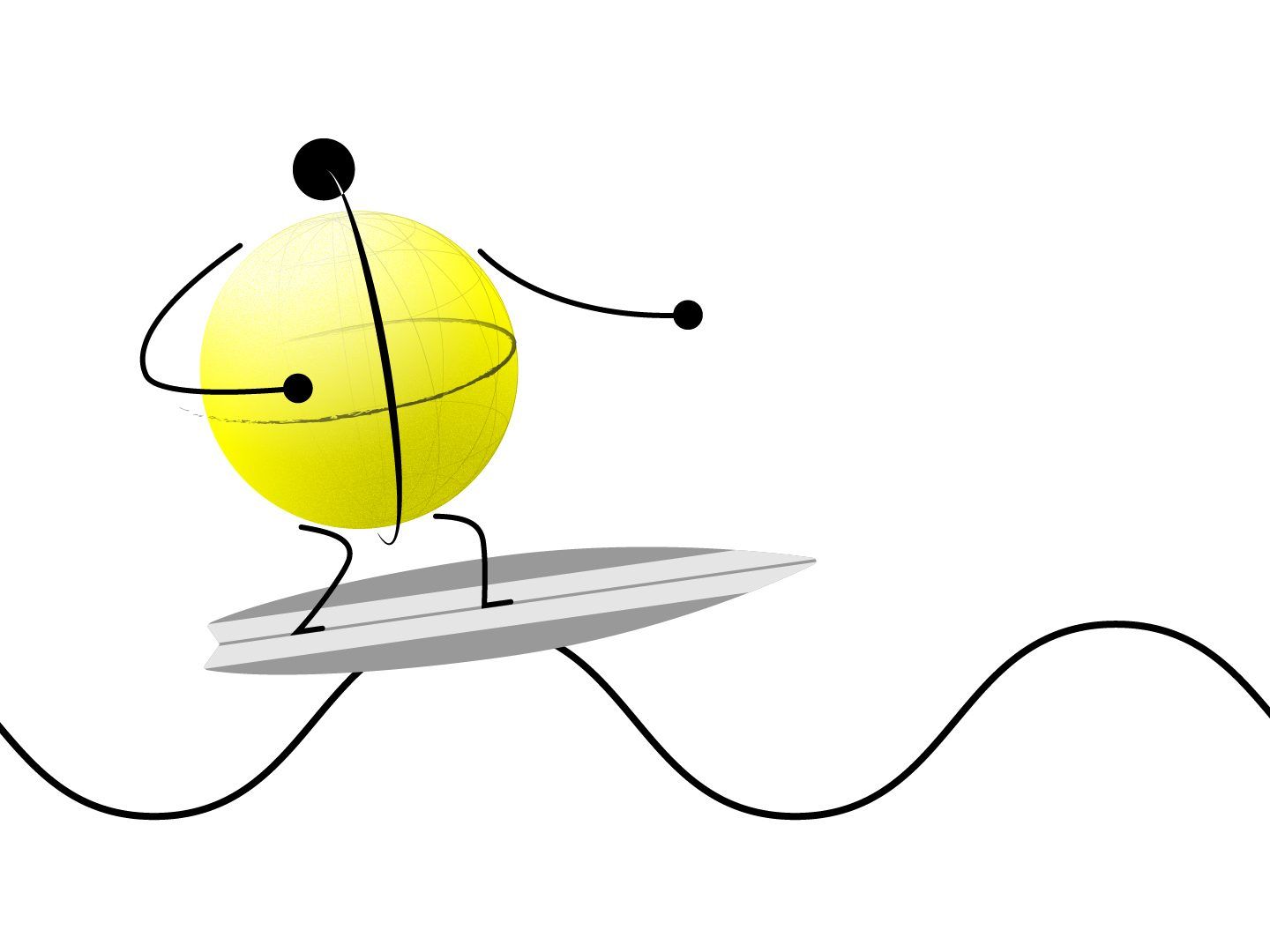
Wave particle duality describes the fact that objects in the quantum world, such as electrons and light, do not behave like the things we encounter in everyday life. They are neither simply particles nor ordinary waves. Familiar concepts such as objects and motion are only of limited use when it comes to fully describing the behavior of quantum systems.
In classical physics, an object is assumed to exist at all times and to move along a well-defined trajectory. In quantum physics, this picture no longer applies. A quantum system is not a tiny particle following a hidden path. Between preparation and measurement, there is no uniquely determined trajectory. Instead, a quantum system is described mathematically by a wave function. This description does not specify where the system is located or which path it takes, but rather which measurement outcomes are possible and how likely they are to occur. These possibilities can superpose and can reinforce or diminish one another. This gives rise to wave like phenomena such as interference. many measurements taken together reveal characteristic interference patterns, while individual measurements always produce a specific, localized event,
Wave particle duality thus highlights that definite properties and precise locations in the quantum world emerge only through measurement. This relationship is fundamental to quantum computing, where superposition and interference are deliberately exploited to amplify desirable computational pathways and suppress others. The wave based description thus provides an essential foundation for quantum information processing.
More selected Quantum principles:
Select a subfield within Quantum principles